
-
Filter ClothBelt press filter mesh belt Horizontal belt vacuum filter mesh belt Vertical filter press filter cloth Filter Press Filter Cloth Breathable mesh Technical fabric - drying Technical fabric - high pressure belt Technical fabric - conveyor belt Technical fabric - fiberboard Joint form Edge banding form Accessories (threading)
Search HistoryClear All Records
- All
- Product Management
- News
[Citius] The application and advantages of nylon monofilament filter cloth in the concentrate industry frame filter press
Release time:
2024-11-14
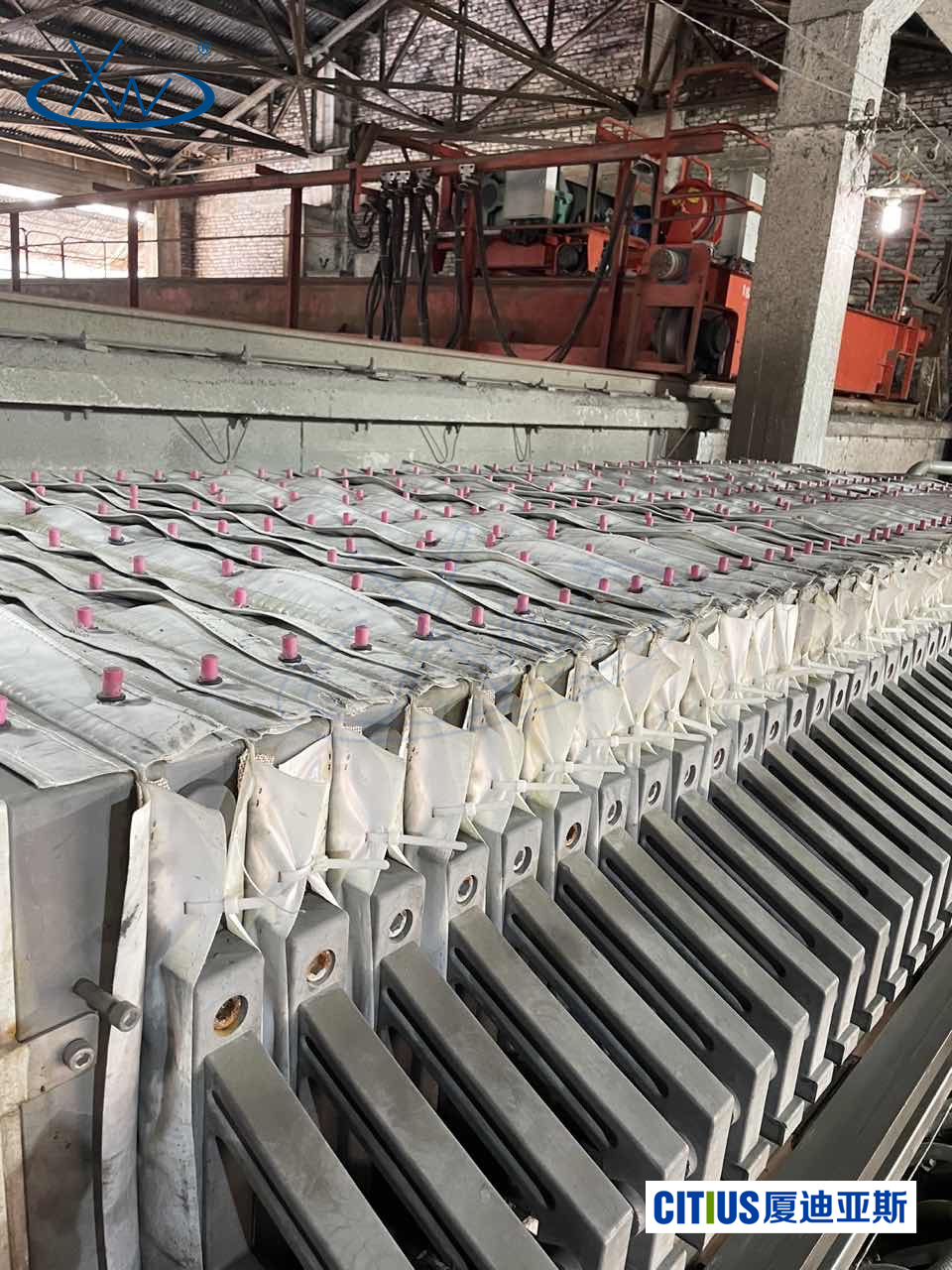
In the concentrate industry, solid-liquid separation is a key process step, especially in the ore processing process. How to efficiently separate solid particles from the slurry is crucial for improving production efficiency and product quality. The plate and frame filter press, as an efficient solid-liquid separation device, is widely used in the concentrate industry. At the same time, the filter cloth, as a core component of the plate and frame filter press, directly affects the filtration effect and the operational efficiency of the equipment. Nylon monofilament filter cloth has been widely used in the concentrate industry due to its excellent mechanical properties, wear resistance, and chemical stability. This article will explore the application of nylon monofilament filter cloth in plate and frame filter presses, particularly its performance and advantages in the concentrate industry.
1. Overview of Plate and Frame Filter Press
The plate and frame filter press is a common solid-liquid separation device widely used in industries such as chemical engineering, mining, metallurgy, and environmental protection. Its basic working principle is to filter slurry through filter cloth by applying pressure between multiple filter plates and frames, where solid particles are retained on the surface of the filter cloth while liquid flows out through it.
The main components of a plate and frame filter press include filter plates, frames, filter cloths, and hydraulic systems. The hydraulic system generates pressure to force the slurry through the filter cloth for filtration, while the filter cloth plays a role in retaining solid particles and separating liquids during the filtration process. The material, pore size, and durability of the filter cloth directly determine filtration efficiency and operational stability.
2. Characteristics and Advantages of Nylon Monofilament Filter Cloth
Nylon monofilament filter cloth is woven from high-strength nylon single fibers and possesses many excellent properties, making it particularly suitable for solid-liquid separation of concentrates in plate and frame filter presses. Its main characteristics and advantages include:
1. Excellent mechanical properties and wear resistance
Nylon monofilament filter cloth has high tensile strength, capable of withstanding high pressure and large flow filtration processes. In the concentrate industry, slurries often contain many coarse particles and hard materials, which pose high demands on the wear resistance of the filter cloth. The wear resistance of nylon monofilament filter cloth can effectively meet this challenge, extending its service life and reducing replacement frequency.
2. Good chemical stability
Concentrate slurries often contain corrosive substances such as acids and bases; therefore, the filter cloth must have excellent chemical stability. Nylon monofilament filter cloth has strong resistance to various chemicals (such as acids, bases, and solvents) and is not easily corroded, ensuring stable filtration performance even in complex chemical environments.
3. Efficient filtration performance
The pore size of nylon monofilament filter cloth can be adjusted according to different filtration needs, effectively filtering solid particles in concentrates. In the concentrate industry, the pore size of the filter cloth is crucial for retaining solid particles. Nylon monofilament filter cloth can achieve efficient solid-liquid separation, ensuring liquid clarity and solid removal rates.
4. Good air permeability and high flow rate
Nylon monofilament filter cloth has good air permeability, which can increase liquid flow speed, reduce filtration time, thereby improving production efficiency. Additionally, good air permeability can also reduce cake accumulation during filtration processes, maintaining stable operation of equipment.
5. Excellent heat resistance
Nylon monofilament filter cloth has good heat resistance and can operate stably within a certain temperature range. During concentrate processing, slurries may be affected by high temperatures; nylon monofilament filter cloth can adapt to higher working temperatures to ensure smooth filtration processes.
3. Application of Nylon Monofilament Filter Cloth in the Concentrate Industry
In the concentrate industry, the choice of filter cloth significantly impacts production efficiency, cost reduction, and equipment lifespan. The application of nylon monofilament filter cloth in plate and frame filter presses can effectively improve solid-liquid separation efficiency during concentrate processing, specifically manifested as follows:
1. Improved filtration efficiency and yield
During concentrate processing, solid particles in slurries are often quite small; traditional filter cloths may not efficiently capture these small particles. Due to its precise weaving structure and efficient filtration performance, nylon monofilament filter cloth can effectively increase solid particle capture rates while reducing clogging of the filter cloths to ensure continuous efficient filtration processes, thereby enhancing overall production efficiency and yield.
2. Reduced maintenance costs
Due to its good wear resistance and corrosion resistance, nylon monofilament filter cloth has a long service life that reduces equipment downtime and frequency of replacing filters while lowering maintenance costs. This is particularly important for the concentrate industry because it has longer production cycles with higher demands for equipment stability and reliability.
3. Improved quality of concentrates
During concentrate processing, the choice of filter cloth directly affects the purity of filtrate and quality of cake. Nylon monofilament filter cloth can effectively remove solid impurities from slurries to ensure high purity and quality of concentrates. For concentrate products that require further smelting, good filtering performance of the cloth can provide high-quality raw materials to ensure smooth downstream processing.
4. Conclusion
The application of nylon monofilament filter cloth in plate and frame filter presses plays a crucial role in the concentrate industry. Its excellent mechanical properties, wear resistance, chemical stability, and efficient filtration performance make it an ideal choice for solid-liquid separation in this sector. By using nylon monofilament filter cloths, the concentrate industry can improve production efficiency, reduce maintenance costs while ensuring high quality concentrates thus optimizing overall production processes. With continuous technological advancements, materials and designs for filters will continue to innovate driving the concentrate industry towards more efficient and environmentally friendly directions.





Add
No. 16-22 Chunfeng East Road, Xiang'an Torch High tech Zone, Xiamen City, Fujian Province, ChinaAll Rights Reserved. | Privacy Policy |
Tel/ WhatsApp