
-
Filter ClothBelt press filter mesh belt Horizontal belt vacuum filter mesh belt Vertical filter press filter cloth Filter Press Filter Cloth Breathable mesh Technical fabric - drying Technical fabric - high pressure belt Technical fabric - conveyor belt Technical fabric - fiberboard Joint form Edge banding form Accessories (threading)
Search HistoryClear All Records
- All
- Product Management
- News
Rare earth industry and filter cloth application
Release time:
2025-03-13
I. Strategic Value and Market Structure of Rare Earths
Rare earth elements (REEs) are an important pillar of modern industry, widely used in high-tech industries such as new energy, electronic information, aerospace, and national defense. They are considered "industrial vitamins". The unique properties of rare earths make them key components of high-performance magnetic materials, optical materials, catalysts, and alloy materials, occupying a central position in the global supply chain.
1. Composition and Properties of Rare Earths
There are 17 rare earth elements in total, including lanthanum (La), cerium (Ce), praseodymium (Pr), neodymium (Nd), samarium (Sm), europium (Eu), etc. These elements are divided into light rare earths (LREE, such as lanthanum, cerium, praseodymium, neodymium) and heavy rare earths (HREE, such as terbium, dysprosium, yttrium) according to their atomic numbers. Among them, heavy rare earths have higher market value due to their scarce reserves and high refining difficulty.
Rare earth materials, due to their unique magnetic, optical, and catalytic properties, play a key role in many fields. For example, neodymium iron boron permanent magnetic materials are widely used in electric vehicle motors and wind turbines; terbium and dysprosium, and other heavy rare earths are used to enhance the high-temperature performance of magnetic materials; europium, gadolinium, and yttrium are used to manufacture LED phosphors and lasers.
2. Global Rare Earth Supply Chain Analysis
Currently, the global supply of rare earths is mainly dominated by China. China not only possesses the world's largest rare earth reserves but also controls the majority of global rare earth processing capacity, accounting for more than 60% of the global market share. Other rare earth producing countries include the United States, Australia, Myanmar, and Russia, but the rare earth supply chains of these countries are not yet fully independent and still rely on China's deep processing capabilities.
In recent years, with changes in the international supply chain landscape, countries have been promoting the localized development of rare earth resources. For example, the United States is strengthening the mining of rare earth minerals and cooperating with allies to establish a complete industrial chain to reduce its dependence on China. At the same time, rare earth recycling technologies are also constantly improving, and some rare earth products have been recycled, improving resource use efficiency.
II. Core Aspects of Rare Earth Processing Technology
Rare earth processing involves many complex stages, from ore mining to the final high-end application materials. Each stage determines the product quality and market value.
1. Ore Mining and Beneficiation
The main types of rare earth ores include:
Light rare earth ores: Such as bastnäsite, mainly distributed in China, the United States, and Australia.
Heavy rare earth ores: Such as ion-adsorption type rare earth ores, mainly distributed in southern China.
Beneficiation technology determines the improvement of ore grade. Common methods include flotation, magnetic separation, and gravity separation. In recent years, with the improvement of environmental protection requirements, beneficiation processes are developing towards green and low-energy consumption.

2. Rare Earth Smelting and Refining
Rare earth smelting mainly includes:
Acid leaching or alkaline decomposition: Using strong acids or strong alkalis to dissolve ores, converting rare earths into soluble compounds.
Solvent extraction: Using organic solvents to selectively extract different rare earth elements to achieve efficient separation.
Chlorination roasting and oxidation roasting: Used to further purify rare earth oxides, improving their purity and application performance.
With technological advancements, modern rare earth smelting is developing towards environmental protection and high efficiency, such as low-acidity solvent extraction, new membrane separation technologies, and wastewater recovery systems, greatly reducing pollutant emissions.
3. Rare Earth Deep Processing and High-End Material Preparation
The refined rare earth oxides can be further processed into high-performance materials, such as:
Permanent magnet materials (neodymium iron boron): Widely used in new energy vehicles, power tools, and wind turbines.
Catalysts (cerium-based catalysts): Used in automotive exhaust purification and petroleum refining.
Optical materials (rare earth phosphors): Used in LED displays, fiber optic communication, and medical imaging.
The preparation technology of high-end rare earth materials determines the competitiveness of the final product, so countries are increasing their research and development investment in the field of new rare earth materials.
III. Xiamen citius's Assistance in the Rare Earth Industry
In the rare earth processing process, solid-liquid separation is a key step in ensuring product purity and improving production efficiency. As a leading Brand in filtration material technology, Xiamen citius Filtration Materials Technology Co., Ltd., with 30 years of industry experience and technological innovation, provides efficient filtration solutions for the rare earth industry, assisting in the refining of rare earth carbonates and chemical rare earth compounds and key processes such as wastewater treatment.

Xiamen citius Rare Earth Processing Site Filter Cloth Diagram
1. Dehydration and Filtration of Rare Earth Carbonates
Rare earth carbonate is an important intermediate product in rare earth smelting, generated by the reaction of rare earth solution with carbonate to form a precipitate. This precipitate needs efficient dehydration to improve the efficiency of subsequent calcination. citius' filtration system ensures a low water content of the rare earth carbonate filter cake, improves the dehydration rate, and optimizes the production process.

Rare Earth Carbonate Processing Site Diagram
2. Purification of Rare Earth Compounds
The preparation of rare earth compounds such as rare earth chlorides, rare earth nitrates, and rare earth oxalates requires efficient solid-liquid separation technology. Xiamen citius' filtration solutions effectively remove impurities, improve the purity of rare earth compounds, and provide a guarantee for the subsequent production of high-end materials.
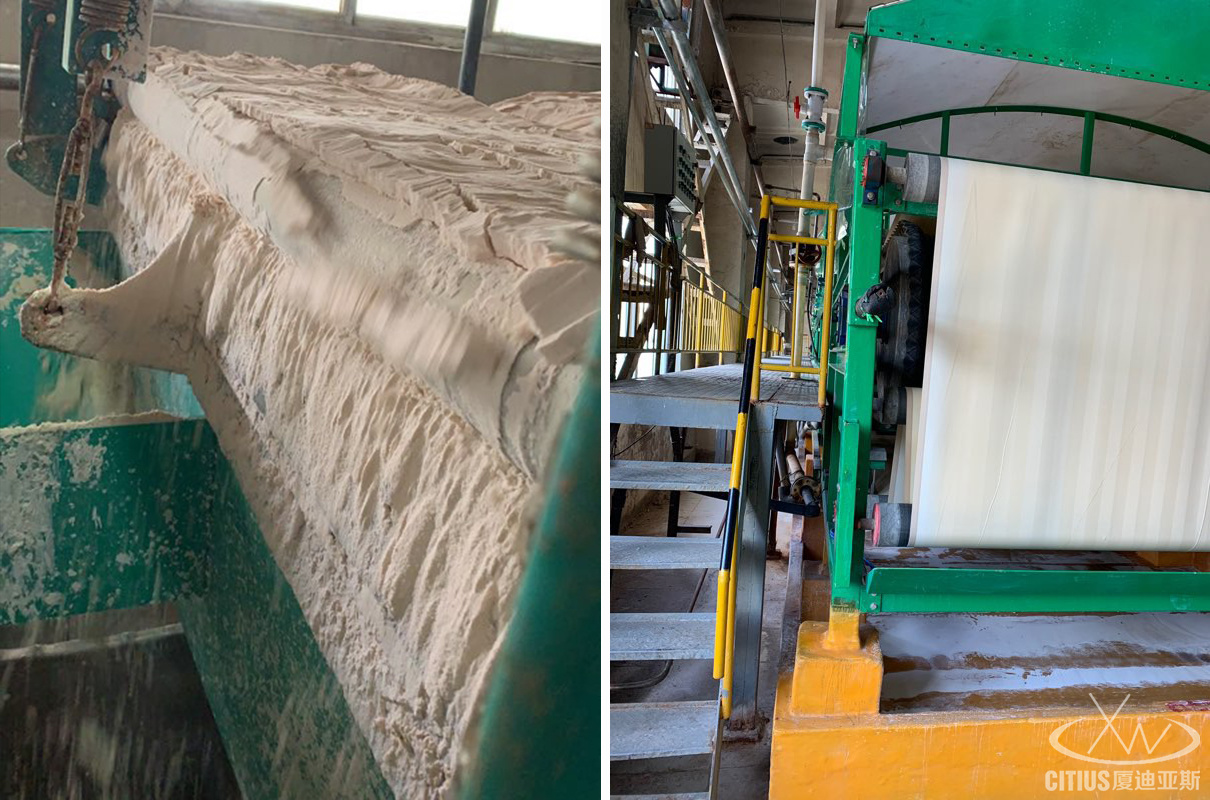
On-site image of rare earth compound processing
3. Wastewater Treatment and Environmental Protection Upgrade
Wastewater generated during rare earth smelting may contain heavy metals, acidic and alkaline substances, and radioactive elements and must be strictly treated. Xiamen citius' filtration system can efficiently remove suspended solids and pollutants from wastewater, ensuring that wastewater meets discharge standards or is recycled for reuse, helping enterprises achieve green production.
IV. Future Development Trends of the Rare Earth Industry
1. Supply Chain Security and Intensified Global Competition
With the growth of global rare earth demand, countries are accelerating the construction of their domestic supply chains and strengthening international cooperation to reduce their reliance on single countries. In the future, the rare earth market will be more diversified, and the competitive landscape will further change.
2. Green Manufacturing and Upgraded Environmental Protection Policies
Environmental standards for the rare earth industry are becoming increasingly stringent, with green smelting, wastewater recycling, and energy-saving and emission-reduction technologies becoming the focus of development. Enterprises need to accelerate technological upgrades to meet higher environmental protection requirements.

On-site image of chemical rare earth compound processing
3. Growing Demand for High-End Applications
The demand for high-end rare earth materials in industries such as new energy vehicles, 5G communications, wind power, new displays, and aerospace continues to climb, driving the rare earth industry towards high quality and high performance.
V. Conclusion
The rare earth industry is entering an important stage of global industrial upgrading and supply chain restructuring. Technological innovation, environmental protection upgrades, and supply chain optimization are becoming the core drivers of industry development. In the extraction, processing, and wastewater treatment of rare earths, the optimization of solid-liquid separation technology is crucial.
Xiamen citius Filtration Materials Technology Co., Ltd.With its excellent technical strength, it provides efficient and reliable filtration solutions for the rare earth industry, helping enterprises improve production efficiency, optimize resource utilization, and promote the development of green manufacturing. In the future, with the continuous upgrading of the rare earth industry, citius will continue to cultivate filtration technology to provide strong support for the global high-end manufacturing industry.

Add
No. 16-22 Chunfeng East Road, Xiang'an Torch High tech Zone, Xiamen City, Fujian Province, ChinaAll Rights Reserved. | Privacy Policy |
Tel/ WhatsApp