
-
Filter ClothBelt press filter mesh belt Horizontal belt vacuum filter mesh belt Vertical filter press filter cloth Filter Press Filter Cloth Breathable mesh Technical fabric - drying Technical fabric - high pressure belt Technical fabric - conveyor belt Technical fabric - fiberboard Joint form Edge banding form Accessories (threading)
Search HistoryClear All Records
- All
- Product Management
- News
Filter cloth for filter presses, belt press filters, and ceramic industry filtration for dewatering tile‑powder slurry.
Share to
Detailed Description
Filter cloth for filter presses, belt press filters, and ceramic industry filtration for dewatering tile‑powder slurry.
Filter type: Belt press filter
Application Industry: Ceramics
Material Handling Description: Dewatering of Ceramic Tile Slurry


In the ceramic industry, the challenge of dewatering tile‑making slurry can be addressed by employing filter cloths for plate-and-frame pressure filters and belt press filters to achieve efficient solid–liquid separation.
In the production of architectural ceramics, from ball milling and slurry preparation to spray granulation and polishing‑water recycling, large volumes of slurry‑like waste liquids containing ceramic powder and mud are generated. These materials typically exhibit fine particle size, high water content, strong stickiness, and pronounced abrasiveness. If not properly treated, they can not only degrade the production environment but also lead to raw material wastage, increased wastewater‑treatment burdens, and higher equipment operating costs.
Especially against the backdrop of the ceramics industry’s ongoing efforts to promote energy conservation, emission reduction, resource recycling, and environmental upgrading, enhancing the dewatering efficiency of ceramic tile slurry, reducing the moisture content of filter cakes, and extending the service life of filtration media have become key concerns for many ceramic enterprises.
Within the entire dewatering system, one of the key factors that truly determine filtration efficiency and operational stability is the filter cloth of the plate-and-frame filter press and the filter belt system of the belt press.
I. Filtration Characteristics of Ceramic Tile Slurry
The main sources of ceramic slurry are:
- Ball-milling pulp tailings
- Glaze filtration residue
- Polishing wastewater sediment sludge
- Spray booth sludge recovery
- Ceramic raw material washing and screening slurry
- Tile cutting and grinding slurry
Such materials typically exhibit the following operating conditions:
1. Fine particles, prone to clogging
Ceramic powders contain a large number of micron-sized particles, some of which are even close to the sub-micron range, which can easily clog the pores of conventional filter cloths, resulting in:
- Permeability decreases
- The filtration rate has slowed down.
- Difficult cake removal
- Increased cleaning frequency
2. The slurry has high viscosity.
Tile‑grinding slurry typically contains clay, feldspar, kaolin, and other constituents, which impart strong adhesion and readily form a dense filter cake on the surface of the filter cloth.
This places higher demands on the design of the filter cloth’s surface structure.
3. Strong continuous production conditions
Ceramic production lines typically operate continuously:
- The filtration system requires long-term stable operation.
- The filter cloth must possess high fatigue resistance.
- High requirements for wear resistance and dimensional stability.
4. High requirements for moisture content control
Many ceramic enterprises aim to recycle mud cakes directly, thus requiring:
- Lower cake moisture content
- Improved squeezing performance
- Higher solid recovery rate
II. Advantages of Using Filter Presses in the Dewatering of Ceramic Slurries
At present, the common dewatering equipment in the ceramics industry mainly includes:
- Plate and frame filter press
- Diaphragm filter press
- Belt Press Filter
- Vacuum filtration equipment
Among them, plate-and-frame filter presses are the most widely used in the treatment of ceramic tile slurry.
The core advantages of a filter press:
1. The filter cake has a low moisture content.
High-pressure pressing can significantly reduce the moisture content of the sludge cake and enhance its recovery value.
2. High solid recovery rate
For fine-particle ceramic slurries, filter presses can effectively retain fine powders, thereby minimizing material loss.
3. Suitable for high-concentration slurries
Even when the slurry concentration fluctuates significantly, it can still maintain a relatively stable filtration performance.
4. High degree of automation
Modern ceramic plants widely employ automated plate‑pulling systems to enhance continuous production efficiency.
However, in practice, the actual performance of a filter press largely depends on the selection of the filter cloth.
III. Key Technical Requirements for Filter Cloth Used in Ceramic Industry Filter Presses
Many companies find that even after upgrading their equipment, performance remains subpar—often because the filter cloth is not properly matched to the operating conditions.
The operating conditions of ceramic slurry impose multifaceted requirements on filter cloths.
1. Excellent water permeability
The filter cloth must simultaneously meet:
- Initial filtration velocity
- Long-term permeability stability
- Not easy to clog pores
If permeability is insufficient, it can lead to:
- The filtration cycle has been extended.
- Processing volume has declined.
- Increased energy consumption
2. Excellent filter cake release properties
Ceramic slurry has relatively high viscosity.
If the filter cake does not detach smoothly, the following may occur:
- Adhesive cloth
- Severe residue
- Frequent manual cleaning
Therefore, the design of the filter cloth’s surface microstructure is particularly critical.
3. High wear resistance
Ceramic powders themselves exhibit significant abrasive properties.
During long-term operation:
- The filter cloth is prone to thinning.
- Warp and weft yarn damage
- Material leakage issue occurred.
Highly abrasion-resistant industrial filter fabrics can significantly extend service life.
4. Excellent dimensional stability
When the filter press operates repeatedly under high pressure:
- The filter cloth is prone to deformation.
- Deviation occurs.
- Seal failure
A stable thermal-setting process can effectively enhance the stability of filter cloths.
5. Excellent chemical resistance
Some ceramic slurries contain the following additives:
- Dispersant
- Grinding aid
- Alkaline additive
Therefore, the filter cloth must possess a certain degree of acid- and alkali-resistance.
IV. Application of Belt Press Filters in the Dewatering of Ceramic Sludge
In addition to plate-and-frame filter presses, an increasing number of ceramic companies are also adopting belt press filters to treat continuous sludge.
Its main advantages include:
- Continuous operation
- High processing capacity
- Relatively low energy consumption
- High degree of automation
Especially suitable for:
- Polishing sludge
- Washed sand slurry
- High-Flow Recirculating Wastewater Treatment
In belt filtration systems, the performance of the filter belt directly determines the dewatering efficiency.
Core Requirements for the Filter Belt of a Belt Filter
1. High-strength tensile resistance
Under prolonged continuous operation:
- The filter belt must withstand high tension.
- Prevent deformation and deviation.
2. Excellent water permeability
The filter belt must rapidly remove free water to enhance pre‑dewatering efficiency.
3. Strong anti-clogging performance
Ceramic fine powders readily penetrate into the fabric.
A well-designed weaving structure can reduce the risk of clogging.
4. Abrasion and flex resistance
Under continuous roll-pressing conditions:
- The filter belt must possess long-term fatigue resistance.
- Maintain a stable lifespan
V. Advantages of Citius’ Filtration Solutions for the Ceramic Industry
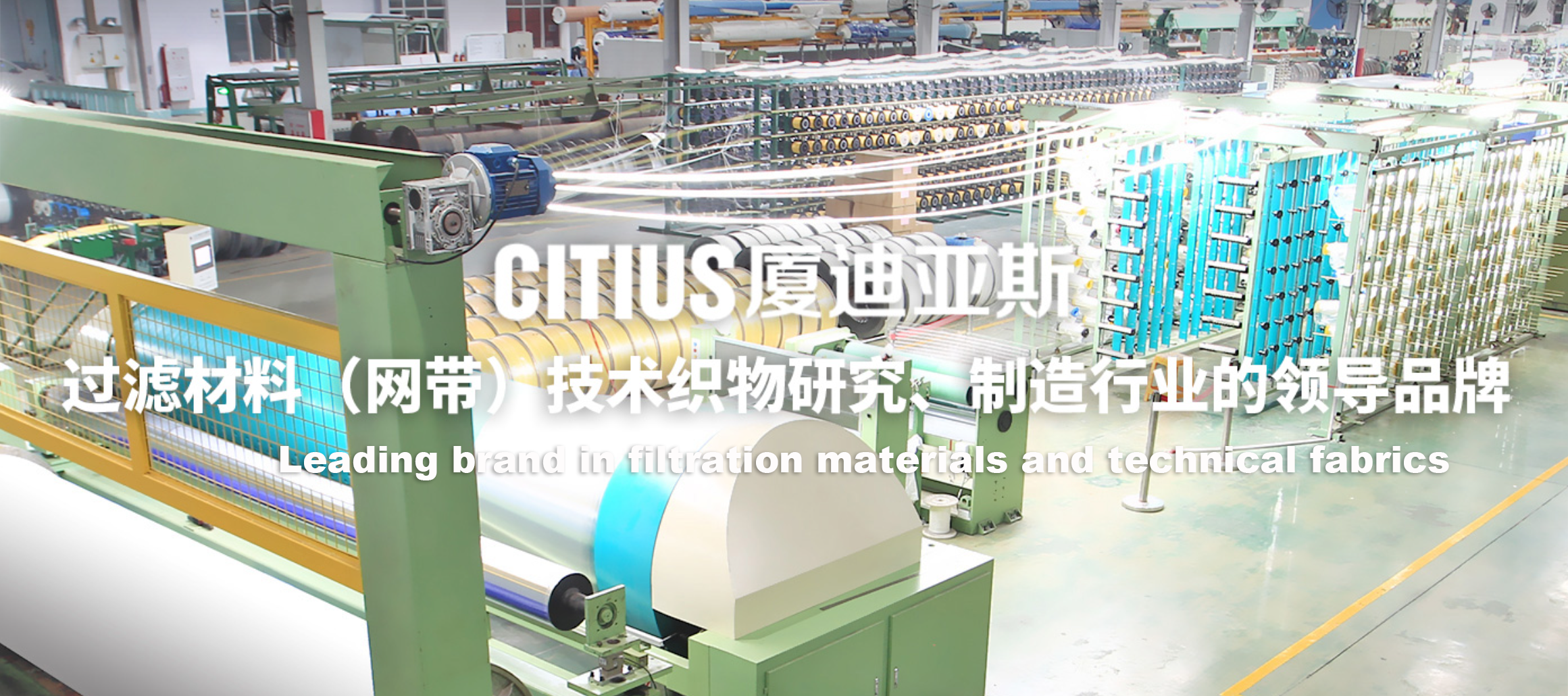
As a leading enterprise in China’s research and manufacturing of filtration materials (mesh belts) and technical textiles, Xiamen Citius Filtration Materials Technology Co., Ltd. Has long been dedicated to solid–liquid separation in the mining, chemical, environmental protection, municipal sludge, and ceramic industries.
Leveraging 30 years of industrial filtration expertise, Citius can provide solutions tailored to ceramic slurry processing conditions:
- Filter cloth for filter presses
- Filter belt for belt press filter
- High-wear-resistant industrial filtration media
- Continuous Dewatering and Filtration Solution
And it can be custom‑manufactured to suit different device models:
- Edge wrapping
- Eager
- Punching holes
- Guide strip
- Apply glue
- Custom-made in special sizes
For the ceramic industry’s high-abrasion, high-viscosity operating conditions, Citius has placed particular emphasis on:
- Filter cloth surface flatness
- Filter cake release performance
- Long-term permeability stability
- High-strength, fatigue-resistant structure
Thereby helping customers achieve:
- Increase processing capacity
- Shorten the filtration cycle
- Reduce the frequency of filter cloth replacement
- Reduce overall operating costs
VI. Future Trends in Filtration for the Ceramic Industry
As environmental protection policies continue to tighten and ceramic enterprises’ demand for green manufacturing grows, ceramic sludge dewatering systems are expected to evolve in the following directions:
1. Higher automation
Reduce manual intervention and achieve continuous, stable operation.
2. Lower energy consumption
Reduce pressing energy consumption and wash water usage.
3. More granular filtering
Increase the recovery rate of fine particles and achieve resource recycling.
4. Longer service life
The service life of filter media will become a key performance indicator for enterprises.
5. Better suited to complex operating conditions
Specialized filtration materials have been developed for high-viscosity, highly fine-particle, and highly abrasive slurries.
Conclusion
In the ceramic industry, during the dewatering of tile‑making clay slurry, equipment serves only as the foundation; the key factor determining filtration efficiency, filter cake quality, and operational stability lies in the compatibility of the filtration medium.
Whether it is the filter cloth for plate-and-frame filter presses or the filter belt for belt press filters, systematic selection is required based on the particle characteristics of the ceramic slurry, the desired moisture content, the equipment’s operating conditions, and the requirements for continuous operation.
In the future, as the ceramics industry places ever greater emphasis on environmental protection, recycling, and intelligent manufacturing, high-performance industrial filtration materials will assume an increasingly pivotal role in solid–liquid separation systems.
For more information on filtration solutions for the ceramics industry, please visit:
Citius Filter Official Website
Email: wyl@citius-filter.com
WhatsApp: +86-13950107241
Add
No. 16-22 Chunfeng East Road, Xiang'an Torch High tech Zone, Xiamen City, Fujian Province, ChinaAll Rights Reserved. | Privacy Policy |
Tel/ WhatsApp